
Buyer's Guide
Best In-Home Sales Training Programs for Contractors (2026)
Contractor sales training compared: live seminars, 90-day coaching programs and per-rep coaching software, with published prices and how to choose one.
TL;DR: What Are the Best In-Home Sales Training Programs for Contractors?
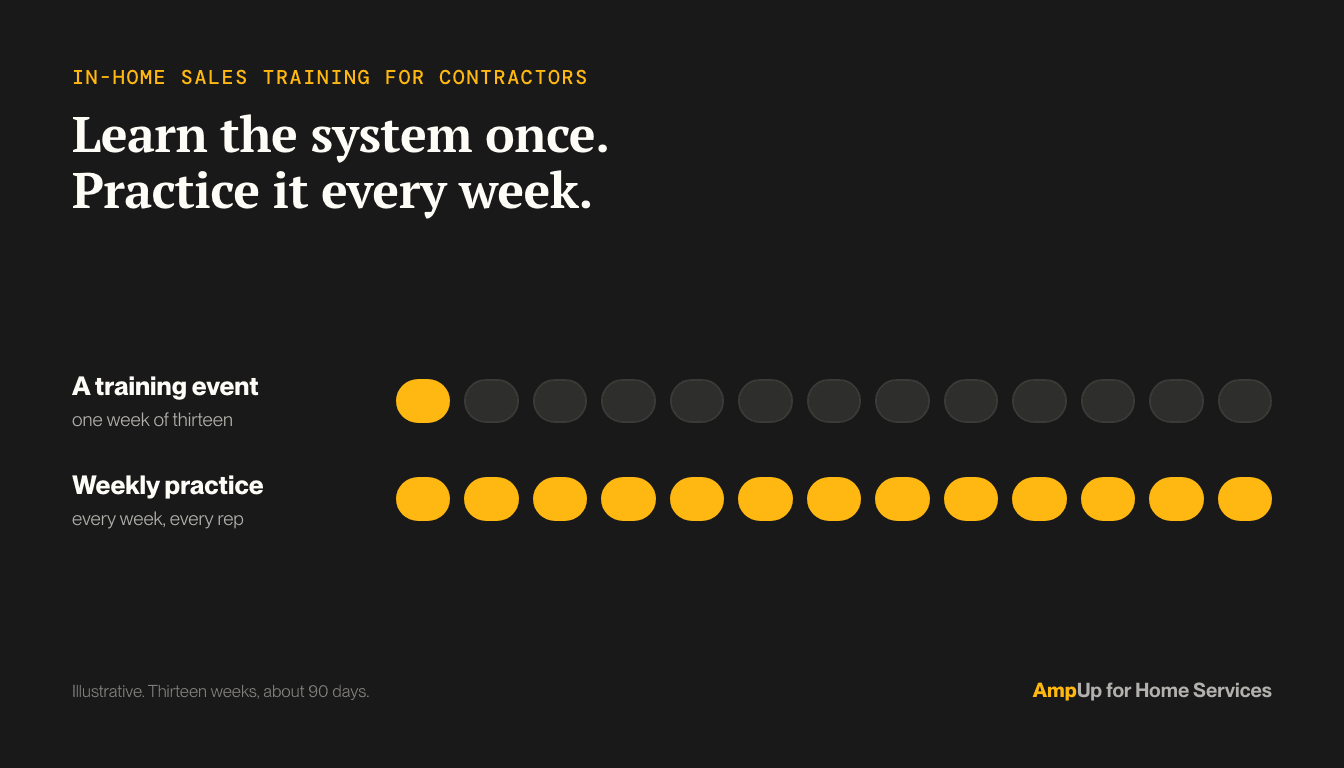
The best in-home sales training is the one your reps keep practicing after the trainer leaves. Grosso University, EGIA and Remodelers Advantage courses teach a system. The Contractor Fight's The Command ($2,400, 90 days) and FPG Warrior Selling add weekly live practice. Coaching software works from each rep's own appointments. Learn a system once; practice every week.
Here is the field as each provider describes it on its own site. We checked every format, length and price on November 5, 2026. Where a price says "not listed", the provider does not publish one. We make AmpUp for Home Services, which sits in the last row, so read that row knowing who wrote it.
| Program | Format and length | Published price |
|---|---|---|
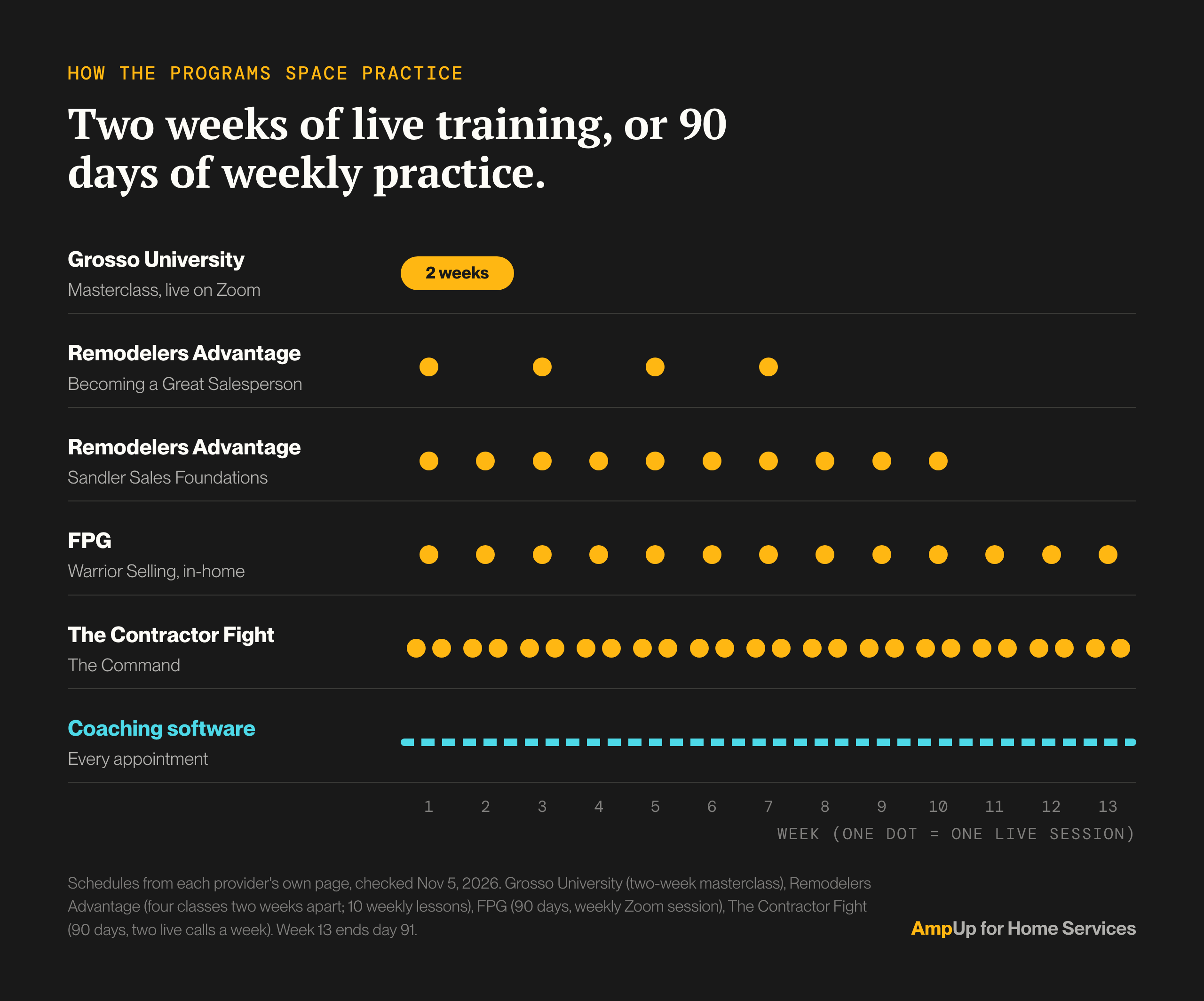
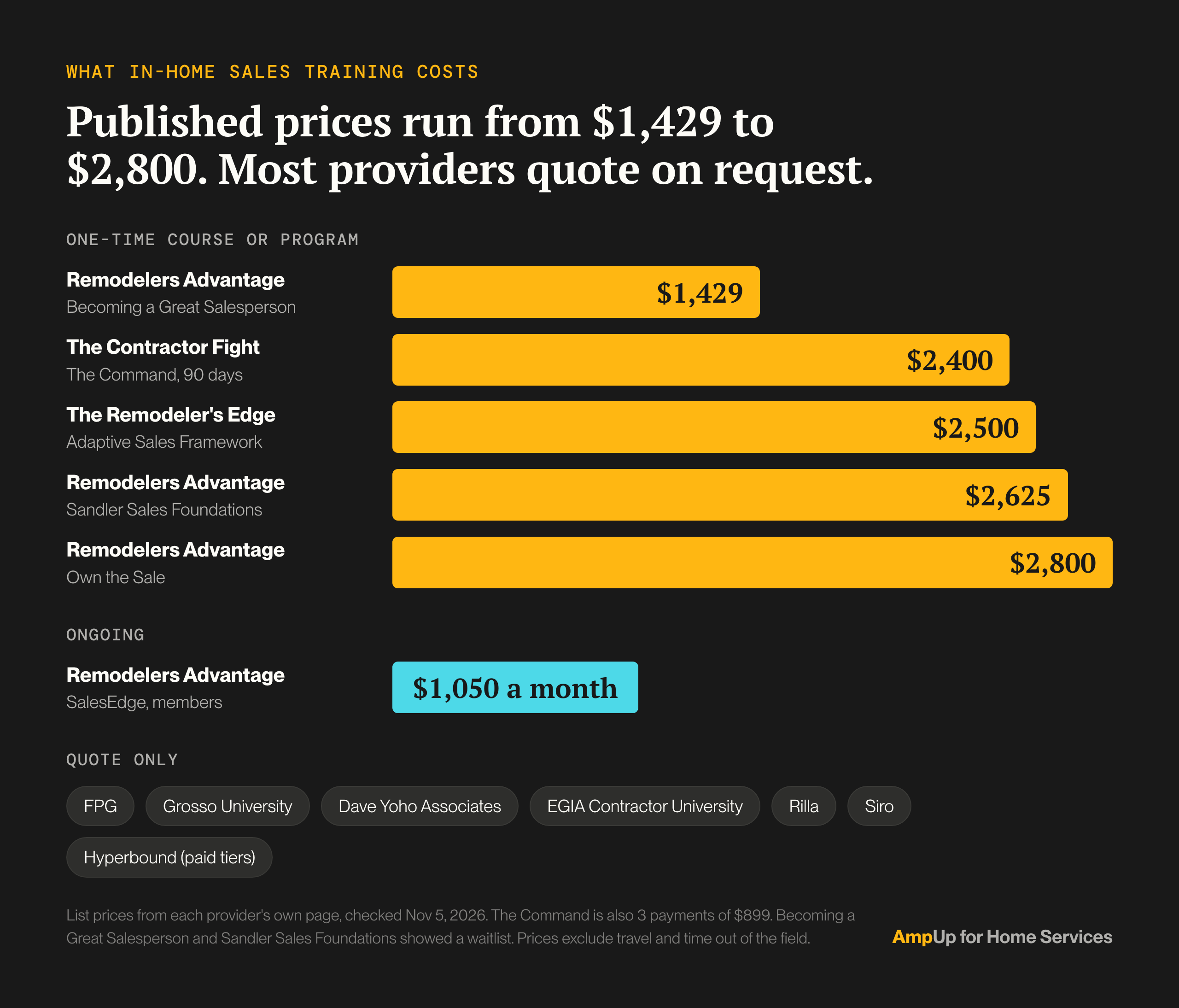
| The Contractor Fight: The Command | Two live calls a week with role play and KPI tracking, 90 days | $2,400, or 3 payments of $899 |
| FPG: Warrior Selling, in-home track | Video lessons plus a weekly live Zoom session, 90 days, about 2 hours a week | Not listed ($500 off if paid in full) |
| Grosso University: Sales Academy Masterclass | Live on Zoom, 11-step system, two weeks; in-person camps of 2 to 3 days in Windsor, WI | Not listed |
| Dave Yoho Associates | Virtual and in-person sales meetings, custom in-home presentations, hourly coaching | Not listed |
| Remodelers Advantage: Becoming a Great Salesperson | Four virtual classes of 2.5 hours, two weeks apart | $1,429 (waitlist) |
| Remodelers Advantage: Sandler Sales Foundations | 10 weekly one-hour lessons | $2,625 (waitlist) |
| Remodelers Advantage: Own the Sale | Eight weeks of live coaching and role play, for women in residential remodeling | $2,800 |
| Remodelers Advantage: SalesEdge | Weekly 55-minute small-group sessions, ongoing | $1,050 a month (members) |
| EGIA Contractor University: In-Home Sales 101, 201, 301 | Online course series; 301 alone has 18 lessons | Not listed (10-day free trial) |
| The Remodeler's Edge: Adaptive Sales Framework | Self-paced video, 21 modules, about 7 hours | $2,500 per person |
| Coaching software (Rilla, Siro, Hyperbound, AmpUp for Home Services) | Works from recorded appointments or AI role play, ongoing | Not listed (Hyperbound has a free tier) |
Already have a system your reps were taught? See how AmpUp for Home Services turns each rep's own appointments into a battlecard built around the gaps that cost them jobs.
Book a demo →The Three Kinds of In-Home Sales Training
Every program in home improvement sales training falls into one of three groups, and each breaks in a different place.
One-time events and courses. A seminar, a camp, a masterclass or a self-paced video course. These are good at installing a system: one sequence for the appointment, one vocabulary, one set of answers to common stalls. They break after the event, when a homeowner asks for two more quotes and the rep folds anyway.
Multi-week coaching programs. Live group calls every week, often for 90 days, with role play and some tracking. These teach a system and then make reps practice it on a schedule, which is the part most training skips. They break on fit. On a group call, the objection of the week is picked for the group, not for each rep, and the program ends on a date.
Per-rep coaching software. Tools that capture appointments, find where each rep loses work and give them practice on it, or that run AI role play on demand. These break if there is no system underneath. Software can show a rep that he quotes one option instead of three; it works better when someone has already taught him how to build the three.
The Best In-Home Sales Training Programs, Compared
Each entry is described from the provider's own public pages, with the price where one is published. We have not attended these programs, so this is a guide to what they offer, not a review of how well they teach.
The Contractor Fight: The Command
Tom Reber's The Command is a 90-day program for contractors doing $300K or more a year. It meets twice a week, live. Wednesday is 30 minutes of training followed by 30 minutes of doing the work on the call: texts, calls and follow-up on dead leads. Friday is live practice on gate calls, price objections, follow-up and closes. Members track four numbers every week: leads, jobs sold, revenue sold and role plays. Replays, scripts and a private community come with it.
Price: $2,400 in full, or three payments of $899, with a money-back guarantee whose conditions (weekly attendance, weekly tracking and a live objection-handling check) are spelled out on the page. Best for: an owner who still runs appointments and wants a twice-weekly practice habit. The program covers the whole sales week, not only the kitchen table. Ask before you buy: whose objections do we practice on Friday, the group's or my reps'?
FPG: Warrior Selling In-Home Sales Training
FPG runs a 90-day B2C and in-home track of its Warrior Selling system, built around about two hours a week: short video lessons of 15 to 20 minutes, plus a weekly live Zoom session it calls the Dojo, led by FPG-certified trainers. The page lists flooring, roofing, kitchen and bath remodeling, solar, HVAC and pest control among the trades it serves, and includes lifetime access to the online lessons.
Price: not listed; the page mentions $500 off for paying in full. Best for: teams that want a named, structured system and a weekly practice slot, without leaving the field for days. Ask before you buy: how big is a Dojo group, and do my reps practice my offer and my price points or a generic one?
Grosso University: Sales Academy Masterclass and Camps
Grosso University teaches an 11-step selling system, and its Certified Closer program credentials reps on the one-call close. Its Sales Academy Masterclass is a recurring two-week live course on Zoom; check the site for the next run. It also runs in-person camps at its campus in Windsor, Wisconsin, such as a three-day Closers Camp and a two-day Spanish-language Campamento de Ventas, plus custom-built presentations, an online learning library and on-site training.
Price: not listed; the site routes you to an application form. Best for: companies that sell on a one-call close and want an intensive reset for the whole team. Ask before you buy: what happens in week three, after the masterclass ends?
Dave Yoho Associates
Dave Yoho Associates has consulted for home-improvement companies since 1962. It offers virtual and in-person sales meetings, custom in-home sales presentations, hourly coaching, seminars and an online program called Super Sales Training.
Price: not listed; it starts with a free 30-minute consultation. Best for: an established company that wants its in-home presentation rebuilt by consultants and its managers coached alongside. Ask before you buy: who keeps the new presentation in practice after the consultants leave?
Remodelers Advantage: Sales Courses and SalesEdge
Remodelers Advantage sells several sales courses aimed at remodelers. Becoming a Great Salesperson is four virtual classes of 2.5 hours, two weeks apart, for experienced remodeling salespeople, at $1,429. Sandler Sales Foundations is a 10-lesson course, one hour each Monday, taught by a Sandler training partner, at $2,625. Own the Sale, an eight-week course with live coaching and role play for women in residential remodeling, is $2,800. Becoming a Great Salesperson and Sandler Sales Foundations both showed a waitlist when we checked.
Its ongoing option is SalesEdge: weekly 55-minute sessions with a small group of non-competing remodelers, for members, listed in the store at $1,050 a month. Best for: remodelers who want sales training from people who sell remodeling, and a standing weekly session. Ask before you buy: when is the next course cohort, and what do members pay for the courses?
EGIA Contractor University: In-Home Sales 101, 201 and 301
EGIA's Contractor University runs an online in-home sales series. In-Home Sales 301: Elevated Sales has 18 lessons and builds on the 101 and 201 courses. Access sits behind a login, with a 10-day free all-access trial.
Price: not listed on the course page. Best for: HVAC and home-services teams who want a structured online curriculum new reps can work through on their own time. Ask before you buy: what does all-access cost after the trial, and is there any live practice in it?
The Remodeler's Edge: Adaptive Sales Framework
Jacquelyn Martin's Adaptive Sales Framework bills itself as an in-home sales system for remodeling professionals: 21 modules of 15 to 25 minutes each, about seven hours in all, with skill builders and field guides. It is self-paced, with on-site training and ride-alongs offered as team upgrades. It says plainly that it is not built for insurance restoration, new construction or commercial work.
Price: $2,500 per person, one time; team pricing on request. Best for: an individual remodeling rep, or a new hire who needs a full system to study. Ask before you buy: who checks that a rep is using the modules in real appointments?
What We Left Out, and Why
We dropped anything we could not confirm on the provider's own page today. Nexstar Network's HVAC sales system is a members' program, but its site was unreachable when we checked. A Sandler franchise's one-day Selling to Homeowners bootcamp listed a date with no year. The only Weldon Long material we found on EGIA's site was a 2018 podcast. If you are an HVAC contractor, ask Nexstar and EGIA directly; both have long histories in the trade. Our HVAC sales training guide covers what to look for in that trade.
Coaching Software: Practice From Each Rep's Own Appointments
A course tells the whole team what good looks like. Coaching software records or simulates the conversation, finds where a rep falls off that standard, and gives them something to practice. None of these vendors publishes a full price list.
- [Rilla](https://www.rilla.com/industry/home-services) records reps' in-home conversations for AI coaching that, in its words, is "tailored to your sales process, your market, and the way your top reps actually win." It lets managers see "the behaviors of every seller, on every appointment, every day," and adds real-time coaching and AI role play. It serves home services, remodeling and home building, among other industries.
- [Siro](https://www.siro.ai/solutions/industry/home-improvement) "records and analyzes in-home appointments, then turns them into coaching, appointment notes and CRM-ready data," with real-time coaching and role play. It lists roofing, windows and doors, siding, bath, basements, decks and solar.
- [Hyperbound](https://www.hyperbound.ai/pricing) is AI role play for sales teams across industries: reps rehearse calls with an AI buyer. Its free tier includes 45 prebuilt role plays; paid tiers are priced per user on a quote.
- [AmpUp for Home Services](/home-services/products/in-home-sales) (ours) learns each rep from their own appointments and coaches them on their own gaps. More on that below.
For a side-by-side of the first two, see our honest comparison of Rilla, Siro and the alternatives. For the questions to ask on any demo, see the buyer's guide to AI sales coaching software for home services.
Is It Better to Send Reps to a Sales Training Seminar or Coach Them In-House?
Do both, in that order: send reps once to learn a system, then coach in-house every week. A seminar gives the team one process and one vocabulary. It is a poor way to make that process stick, because practice spread over weeks beats the same practice crammed into one sitting.
Cepeda and colleagues pooled 839 assessments from 317 experiments in 184 articles (Psychological Bulletin, 2006). Spaced practice beat massed practice, and the longer you need to remember something, the wider the best gap between sessions. Those studies tested verbal recall, such as word lists and facts, not closing a roof at a kitchen table, so read it as the direction of the effect, not a forecast for your team.
The forgetting curve points the same way. Murre and Dros repeated Ebbinghaus's 1880s experiment in 2015: one person spent about 70 hours learning and relearning lists of nonsense syllables, and the curve matched the original, with the steepest loss in the first hours and day. A sales system is not nonsense syllables, and a rep who uses a skill on Monday's appointments probably holds it better. What carries over: whatever isn't used and refreshed fades, fastest right after the lesson.
Then count what the seminar costs beyond the ticket: reps sent, times days away, times appointments each rep runs a day. As an illustration, four reps at a three-day camp who each run two appointments a day leaves 24 appointments to reschedule or hand off, before travel.
In-house coaching has the opposite cost: little cash, a lot of manager time. A manager can ride along with two or three reps a week, and the rest get a huddle; we cover that limit in why ride-alongs don't scale. The teams that coach well keep sessions short, pick one gap per rep and repeat it until it holds. Teaching once is information. Repeated practice is what shows up at the kitchen table.
Is Role-Play Training Worth It for In-Home Sales Reps?
Yes, if it is built around the stalls your reps actually hear and repeated every week. Role play is the practice half of what researchers call behavior modeling training: show the right move, practice it, get feedback. Taylor, Russ-Eft and Chan reviewed 117 studies of it (Journal of Applied Psychology, 2005). The effect was largest on what trainees learned, smaller on what they did on the job, and smaller still on business results. Knowledge faded over time, while skills and on-the-job behavior held steady or grew.
The same review found what makes practice carry over to the job: trainees building their own scenarios, setting goals, seeing both good and bad examples, and supervisors trained to back it up. The closest everyday version is role play built from the stalls the rep actually lost on, with a manager who asks about it on Monday. A role play from a generic script, done once at a training day, mostly teaches the script. Our guide to AI sales role play for in-home objection handling shows how to build scenarios from real stalls.
What's the Best Way to Onboard a New In-Home Sales Rep?
System first, then supervised appointments, then weekly practice on their own gaps. Give the new rep your sales process and one course to learn it from. Have them sit in on a top closer's appointments, then run their own with a manager present for the first few. After that, switch to short weekly role plays on whatever they keep stumbling over.
The slow part of onboarding is usually the gap between a rep blowing an objection and learning what to do the next time. Our guide to cutting new comfort-advisor ramp time walks through closing that gap week by week.
How to Choose a Program: Start With the Gap Your Reps Actually Have
Every program above promises better closing. The useful question is which one trains the thing your reps do wrong. In most teams it is one of three behaviors, and reps already know the right move; they stop doing it when the appointment gets tense.
Gap 1: Quoting One Price Instead of Building Options
A single quote turns the appointment into a yes-or-no decision, and price becomes the only thing the homeowner can push on. The window rep who walks through a builder-grade, a mid-range energy-efficient and a premium triple-pane tier is having a conversation about which version fits. The rep who writes one number on the proposal is having one about whether the price is too high. Every system above teaches options; what fixes it is rehearsing the options presentation until it is the easy path on a late Saturday. Our in-home consultation framework shows where options fit.
Gap 2: Bringing Up Financing After Sticker Shock
Reps know financing exists. They lose jobs by mentioning it after the homeowner has flinched at the total. Chase Boyce, VP of Sales at HomeTown Services, described the shift to ServiceTitan: "Five years ago, it was, 'We offer financing if you need it.' Now you have to say to a homeowner, 'This is what you're getting and here's exactly how you can afford it.'" On a five-figure tub-to-shower conversion, the rep who puts the monthly payment next to the total the first time it appears keeps the homeowner in the conversation.
Gap 3: Folding on "I Need to Think About It"
Your rep can explain how to handle a stall in a training room. Then a roofing customer says "let me sleep on it" and the rep packs up the samples inside ten seconds, without asking what the homeowner is actually weighing. You can hear it on a recording: the rep who handles the stall spends a few minutes finding the real hesitation; the rep who folds books a follow-up. Live role play is what moves this one. See our guide to objection handling training.
Find the Gap in One Week
Before you buy anything, spend five working days finding out which gap each rep has. Don't ask the reps: they misremember their own appointments, and you need the recording, not the recollection. By Friday you want one page per rep, not a team average that hides who needs what.
- Monday and Tuesday. Pull five to seven recent appointments per rep. If you record appointments, the audio is already there. If not, ride along on a handful and take timestamped notes instead of coaching in the moment.
- Wednesday. Count the options. How many price tiers did each rep put in front of the homeowner on each visit?
- Thursday. Note when financing first came up, next to the price or after a flinch. Then time how long the rep stayed in the conversation after the first stall.
- Friday. Write the one-page profile: the rep's name, the one gap costing them the most jobs, and two or three timestamps so the rep can hear the moment for themselves.
No system yet: a course or seminar. Reps know the system but fold under pressure: weekly live practice, such as a 90-day program or SalesEdge. A different gap for every rep: practice built per rep, which is where coaching software fits.
Curious what your team's one-page profiles would say?
Bring a week of recent in-home appointments and we will show you the gap each rep loses jobs on, and what they would practice before their next appointment.
Book a demo →Where AmpUp for Home Services Fits
AmpUp for Home Services is not a seminar, and it does not replace one. It keeps whatever system your team was taught in practice, one rep at a time. Every appointment is captured and analyzed, and each rep gets a coaching profile that sharpens with every job: what they do well, where they lose work, what changed since last month.
Before the appointment, the rep gets a battlecard on their phone: what the customer said on the booking call, that rep's two focus points from their own past appointments, and the lines that work for the objections this customer is likely to raise. After it, a recap updates the profile and picks the next thing to work on. Role plays are built from your company's own presentation and customers, so reps practice the way your company actually sells. Managers coach by exception: AmpUp tells them who needs help and with what, without the drive time. It integrates with field-service and CRM systems such as ServiceTitan, Jobber and HubSpot.
A 30-Day Plan for After the Training
Whatever you buy, the month after it decides whether it worked. Week one is the five-day audit above. Weeks two through four belong to practice: one short role play a week per rep, aimed at their named gap and nothing else, using the words homeowners actually used on your appointments.
At day 30, run the audit again and compare the same three signals: options on the table, when financing came up, and time spent after the first stall. Then pick each rep's next gap and repeat.
See your team's first battlecards
Bring a week of recent in-home appointments. We will show you which gap is costing each rep the most jobs, what AmpUp would coach this week, and what each rep would practice before their next appointment.
Book a demo →Frequently Asked Questions
What is the best in-home sales training for a small contractor?
For a small team, pick one system and a cheap way to keep practicing it. A self-paced course or an online series such as EGIA's In-Home Sales courses teaches the system; a 90-day live program such as The Contractor Fight's The Command ($2,400) adds twice-weekly practice for owners who still sell. If the owner coaches, a short weekly role play on each rep's own gap does more than a second course.
How much does home improvement sales training cost?
Among programs that publish prices, single courses ran from $1,429 to $2,800 when we checked on November 5, 2026, and The Command's 90-day program was $2,400. Remodelers Advantage's SalesEdge is $1,050 a month for members. Most others, including FPG, Grosso University, Dave Yoho Associates, Rilla, Siro and Hyperbound's paid tiers, quote on request. Add travel and the appointments missed while reps are away.
Is online sales training worth it for in-home reps?
Online lessons are a fine way to learn a system, and live online sessions are a cheap way to practice it without losing days in the field. What matters is whether there is live practice with feedback. A video course with no role play teaches what to say; it does not make the rep say it under pressure at the kitchen table.
How long should in-home sales training take?
Learning a system takes days to a few weeks: the Grosso masterclass runs two weeks and the Adaptive Sales Framework is about seven hours of video. Making it stick takes ongoing weekly practice, which is why The Command and FPG's in-home track run 90 days.
How do I train my reps to sell in the home without feeling pushy?
Train the sequence, not the script. Reps feel pushy when price and financing arrive late, as a reaction to the homeowner's flinch. Rehearse building options and putting the monthly payment next to the total until the calm version is the default. Our in-home consultation framework lays out the full sequence.
What is the difference between in-home sales training and in-home sales coaching?
Training teaches the system once: the sequence, the options, the answers to common stalls. Coaching reinforces it repeatedly, one rep and one gap at a time, until the rep does it under pressure. A rep who knows good-better-best but quotes one price on a tense Saturday needs coaching, not another course.
Do I still need training if I use AI coaching software?
Usually, yes. Software finds where each rep falls short of your standard and gives them practice, but someone has to set that standard first. Teach a system once, through a course, a program or your own best closer, then use software to keep each rep practicing their own gaps every week.
How often should in-home reps practice role plays?
Weekly, in short sessions on one gap at a time, because spaced practice beats one long day. Use the stalls your reps actually heard and repeat the same one until the rep handles it on real appointments.
Related reading
See AmpUp on your own calls
Bring a week of recent in-home appointments. We will show you the one gap costing each rep the most jobs, and what they would practice before the next round of calls.
See a demo